
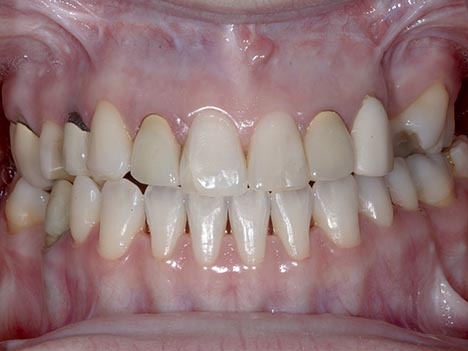
 Before
Black line at gum line
This Chicago Northshore resident complained as a new patient that her recently done crowns did not match her natural teeth nor each other. The floss would shred when used around her dentistry and the gums would bleed. Knowing that bleeding is not normal, she felt that her dentistry did not fit well. Her gums were receding from around the crowns one year after placement. Some of her new crowns had black lines at the gumline. She dreamed of having a pretty white smile and wanted her dentistry to be easy to clean.
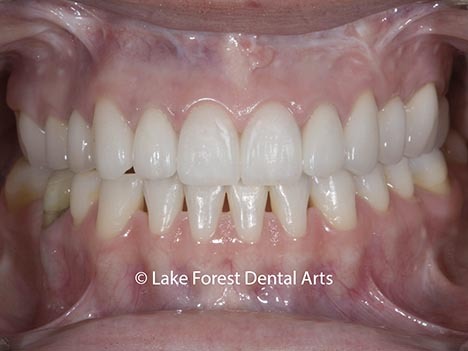 After
AfterFix Dark Lines at the edges of crowns
The patient elected to have new dentistry (veneers, crowns or bridges) done to replace or cover over and reshape all of her upper teeth. Our patients have the opportunity to decide how they want their porcelain to look. This patient wanted a bright and white look with less variation in color going from the gum to the edges of her teeth. Translucency in natural teeth often is what creates this variation. These restorations were done without translucency at the patient's request.
Black Line at Gumline: Edge of crown is dark
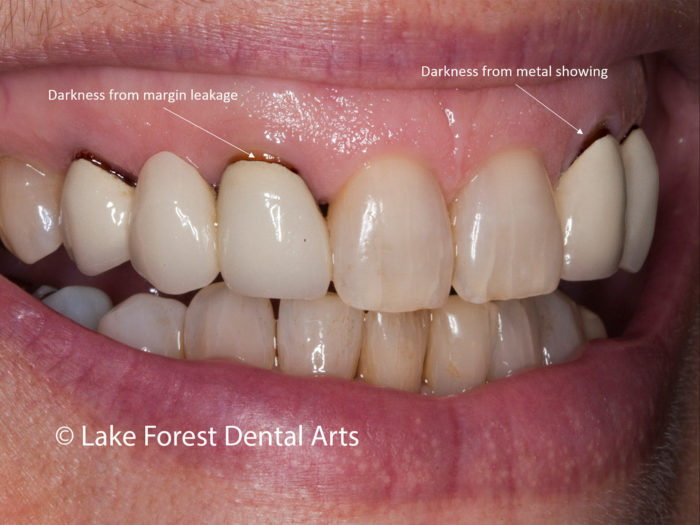
Is the edge of your new crown dark? Nothing is more unsightly than a black line visible at the base or edges of your dental crowns. This is especially true if you have a big smile and the crowns with black lines show up in pictures. Some patients call us complaining of a dark tooth under a crown. However you describe this gray or dark ring around base of crowns, this mystery is fairly common. It is caused usually by how the crown is made. Many patients think they have dark gum tissue when in reality, it is darkness at the edge of a crown. These crowns with black lines at the gum line are usually evident on lower quality dentistry or older restorations done 15+ years ago.
How can you avoid a Black Line at the Crown Margin?
A dark gray or black ring around base of crown is possible whenever metal is used under the porcelain. Porcelain-fused-to-metal – or PFM crowns have an opaque metal alloy substructure (often called the coping) that seals the tooth and offers support for the ceramic that is stacked and baked on top.
Metal with a low gold content is dark gray and is easily seen if not covered. Even 14-karat gold alloys will create a darkness at gum line. PFM crowns can be beautifully crafted by a skilled dentist-technician team. Even still, it is much more difficult to keep this type of restoration looking good long term. Metal gives the crown strength, while the porcelain on top gives it an aesthetically pleasing look.
Gray or black at the gum line can be present if the border (or margin) of the crown is exposed. All porcelain crowns made with high translucency are more difficult to fabricate, but they do not have any metal, and are therefore often chosen as the most aesthetic option.
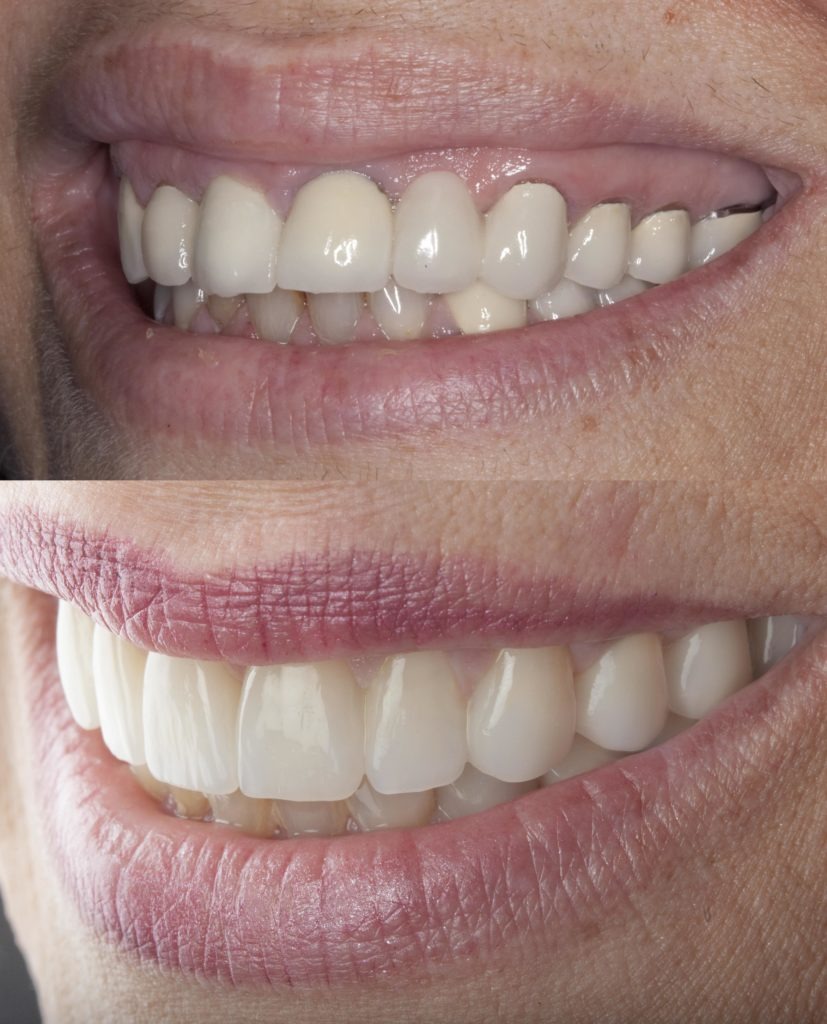
The black line at the gumline of crowns is often the exposed metal substructure of less expensive crowns. This patient elected to have cosmetic dentistry with crowns that have no metal. She also had a gum lift to get rid of the excessive gum display when she smiled. The darkness at the gum line had been corrected.
Fix Dark Line at the edge of PFM crowns
The average PFM crown will have metal at its border. It is the gray metal showing that is so unattractive. The porcelain does not cover the ugly metal edge. A higher quality dentist will pay extra for the dental technician (who actually makes the crown) to cut back the metal margin and bake a special “margin porcelain” to seal the crown. When the edge of the crown is all porcelain, it will be far more attractive.
Can a High Quality Crown Have a Black line at the Gumline?
Yes, but not often and it shouldn’t happen for many years. There are four possible scenarios, which we will explore below.
Opacity of metal base blocks the light
Natural teeth are surprisingly translucent. When light hits part of a tooth, the light is bounced around within the entire structure, including the root. The gum is actually illuminated by the lightened root and will appear a lighter shade of pink. If one of the teeth in your smile has a PFM crown (still the most commonly done type of crown), the opaque metallic coping will prevent light from going up the root. The gum (not the crown) will appear darker. It may seem as though you have a black tooth under the crown. A porcelain butt joint margin allows more light in the root but there is still less light going down the root.
Flexure at margin will break the seal and cause the edge of the crown to be dark
When a patient grinds his or her teeth, large lateral forces are exerted, causing flexure of the teeth. When there is a crown on a tooth, the flexure point will be at the crown margin. Over time, the cement used to seal the margins will slowly break down and begin to leak. Even with the highest quality crowns with porcelain butt margins, if there is leakage, there will eventually be staining. This staining will eventually cause darkness at the gumline. This black line a the gumline or at the base of a crown can even make the gums appear black.
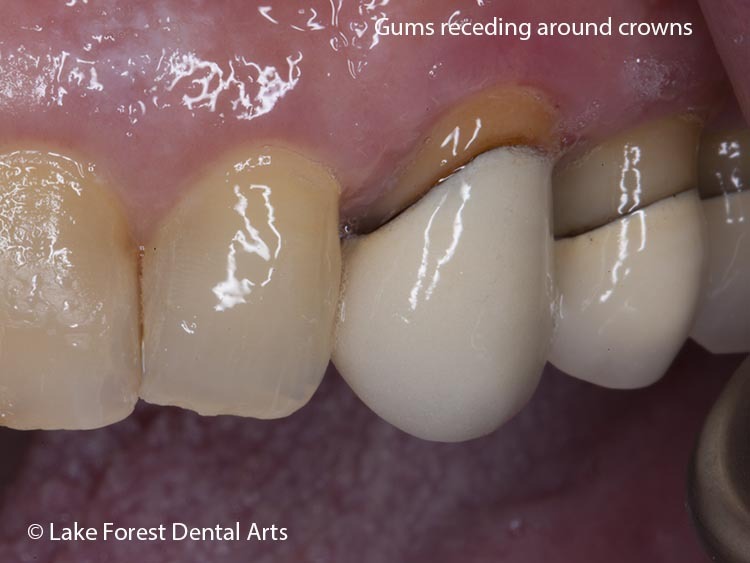
Our patient came in asking, “why are my gums black?”. A cosmetic dentist could easily replace the dentistry with pretty crowns.
No contact lens effect
Translucent porcelain can assume a contact lens effect at the margin. This makes margins virtually invisible; even with gum recession. Some types of well made Empress porcelain crowns can have a darkness at the gum line. This can occur if the crowns were originally made to make the teeth brighter for cosmetic reasons. Porcelain crowns and veneers that are used to brighten the teeth are created using more opaque porcelain to mask the dark tooth below. Opaque porcelain margins do not have a contact lens blending effect and will be visible after gum recession occurs.
That black line a the gumline might be caused by periodontal disease or gum recession which exposes the margin
It takes more effort but dentists can tuck the margin of a crown beneath the gum line. This will hide the visual interface between the crown and the natural tooth root. As we age, our gums can recede. Good oral health from brushing and flossing your teeth and gums can slow the process down. Unfortunately, good oral hygiene may not stop gum recession. Five to 20 years after the crown is placed, gum recession may expose the margin. Planning for the future, the margin of the crown is stained by the lab technician to match an assumed shade of the root that the dentist cannot see. Often the optical properties of the crown and root are mismatched.
What else will make the edge of a crown dark?
In the past, if decay formed at the edge of a crown, it was common for dentists to patch it with a silver filling. Silver fillings get black as they get old. Not only will the filling make the tooth dark, but it can also cause an amalgam tattoo. Some remnants of the filling material can get incorporated within the gum tissue. It can look like there are dark spots on your gums but really the gum tissue turns black.
To learn more about custom fitted crowns with no darkness at the gum line, contact us at 847-234-0517.