

Nighttime tooth grinding or bruxism cause tooth wear
This patient was a heavy bruxer. She had worn a night guard over most of her adult life. She really wanted a nicer smile. There was a concern that she would break her dentistry just like she did her natural teeth. Over the years, this patient broke, chipped, or fractured many of her teeth.
Her dental work did not look nice. The old crowns and fillings did not match and did not compliment her smile. She wanted the feminine tooth shapes back that she had lost many years ago from her tooth grinding.
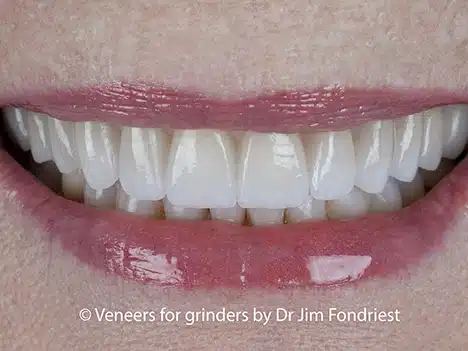
Veneers for Grinders - Replacing lost tooth length
New porcelain technology has an answer for nightime grinders. E Max porcelain can be used in a monolithic form (one layer) that is very strong and unlikely to chip. This resident of Chicago's Gold Coast was referred to Dr. Fondriest by her general dentist for a second opinion and treatment. She wanted very specific tooth shapes and took an active role in designing how her new smile was to look. She also wanted to have little or no tooth structure removed during the process.
Her treatment consisted of crowns to replace her old crowns, minimal preparation (Prepless) veneers on her incisors, and normal veneers to replace her old veneers on her eye teeth. Her goals to have a more symmetrical smile with teeth that had more uniformity of color and were not worn. She was happy she chose to get a second opinion. See her portrait.
Veneers for Grinders | Can you have veneers if you grind your teeth?
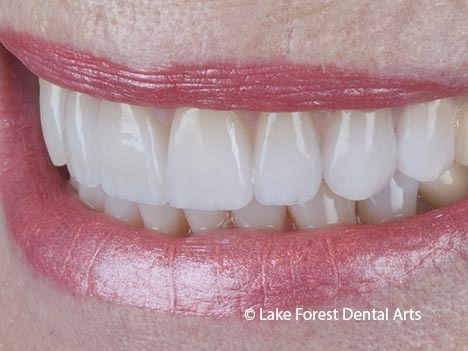
Grind proof veneers for patients with bruxism are becoming a reality. Bonded monolithic EMax to restore lost tooth length is a perfect long term solution. They also create beautiful smiles.
YES!!! Yes you can have veneers if you grind your teeth. Porcelain veneers for grinders can be made to last. We find that these special veneers hold up very well. New protocols have been developed for restoring your teeth if you grind at night. The porcelain used for these veneers is selected to match the wear characteristics and tensile strength of natural teeth. In other words, it wears and functions just as enamel does.
In the past, the first choice for grinders would be PFM crowns. The porcelain selected for these restorations was ultra hard. We have found that it is not advisable to use porcelain that is harder than enamel. The PFM’s of the past had been made with super hard porcelain with bad outcomes. If the porcelain is too hard, it acts as an abrasive to the opposing teeth. The lower teeth will just wear down faster. When the porcelain has the same hardness, the veneers will passively wear at the same rate as the opposing teeth. Matching nature is better!
It is normal for natural teeth to wear and to chip if overloaded. These special veneers for grinders have the same chance of wearing and chipping. Patients with extreme grinding habits are encouraged to wear night guards as a logical precaution.
Damage from Nighttime Tooth Grinding
Tooth length will diminishes over time with night grinding. Gnashing of teeth or grinding is a common condition. It is estimated that 70% of people clench or grind their teeth. About 20-25% of the population grinds enough to cause serious damage to their teeth. Night grinding has genetic links. If family members grind, there is a good chance that you do. It is thought that stress will amp it up but it doesn’t cause it. When teeth grinding continues for months or years at a time, tooth length will be compromised.
The loss of tooth length happens gradually with habitual grinding. Most sufferers don’t realize that it is happening. It is common to loose 40% of the length of the front teeth before it is noticed. Usually patients notice chipping or a shape change first. Once more than 50% of the tooth is missing, it becomes more difficult to repair the teeth with more conservative solutions such as veneers. It is important for your cosmetic dentist to monitor the wear on your teeth. If it progresses too far, then veneers cannot be done. When more than half of the exposed tooth is missing, then gum surgery and crowns are likely to be recommended.
What Causes Teeth Grinding?
Teeth grinding encompasses the gnashing or clenching, of the teeth. There are causes of teeth grinding. Some include:
- Sleep
- Stress
- Anxiety
- Certain medications
- Genetics
Many individuals succumb to teeth grinding during their sleep. As a consequence, they find that the length of their teeth has been diminished. Individuals may also experience pain in the jaw and mouth, due to the pressure that teeth grinding creates.
Veneers for Grinders made with Emax monolithic porcelain is ideal for replacing lost tooth structure
The newest porcelain to enter the dental world is EMax. Normally, it comes in two layers, a strong coping substructure that has a tensile strength of 450 mega pascals (MPa), and a top layer of veneering porcelain that allows custom characterization that averages 85 MPa. Normally, that is strong enough for a long lasting restoration. When a patient grinds heavily, this veneering porcelain can chip. E Max technology has now advanced to the point that the coping alone has beautiful natural optical characteristics. EMax Monolithic is both a beautiful and strong one layer restoration.
Recent studies show that even the most aggressive people who grind do not break the monolithic Emax porcelain. The restorations in the featured case above were created with 95% EMax Monolithic with only a small buccal window of veneering porcelain used.
After you get your custom porcelain veneers, it is best to wear a bite guard to protect your oral health. Routine visits are recommended to check your veneers and teeth grinding.
Learn more about veneers for grinders and how to restore lost enamel
Dr. James Fondriest provides custom porcelain veneers that can replace tooth length, caused by teeth grinding. These grind resistant veneers can restore teeth to a natural shape and length. If you would like to learn more about dental veneers to combat lost tooth length, schedule a consultation with Dr. Fondriest by calling 847-234-0517.
We look forward to providing you with the finest in cosmetic dentistry and general dental care. , in a welcoming environment.
Dr. Fondriest is a Nationally recognized and highly sought after cosmetic dentist serving clients from throughout the United States