
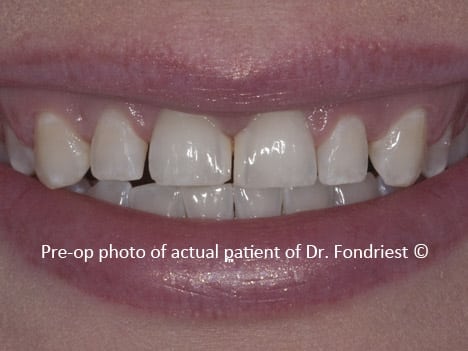
 Before
This Highland Park, IL patient was concerned that she showed too much gum on the sides of her smile. Her front teeth were too short and too small for her face. When the front teeth are shorter than the side teeth, it is called a "reverse smile line".
She wanted her teeth to look better. Her old dentist was replacing the bonding that filled the gaps between her teeth every 5 years. She was a nighttime tooth grinder and the composite bonding chipped frequently. Her dentist was worried that if he placed veneers, they would break off due to the bruxism.
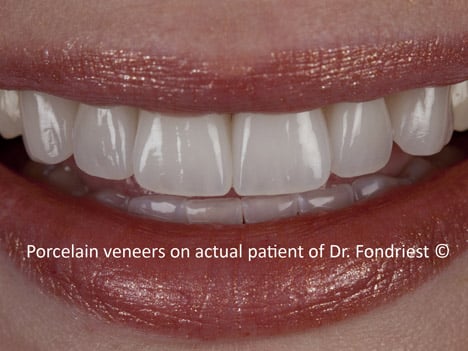 After
AfterMaking the "smile line" follow the contour of the lower lip, natural optical qualities of feldspathic porcelain. The patient had bilateral "gum lifts", also called crown lengthening, to reduce the amount of tissue showing in her smile from side views. Six feldspathic porcelain veneers were placed on her front teeth. Feldspathic porcelain has the optical characteristics that most closely match natural teeth. The veneers were used to fill the gaps between the teeth and to give her a more appealing smile line.
Porcelain veneers are an ideal restorative option to fill gaps or spaces between the teeth. Many dentists will drill too much tooth structure away when they prepare teeth for veneers. When your dentist has a light touch with the drill and leaves the majority of enamel in place, the veneer bond is extremely high and the tooth is actually strengthened by the new veneer.
Understanding Feldspathic Porcelain Veneers
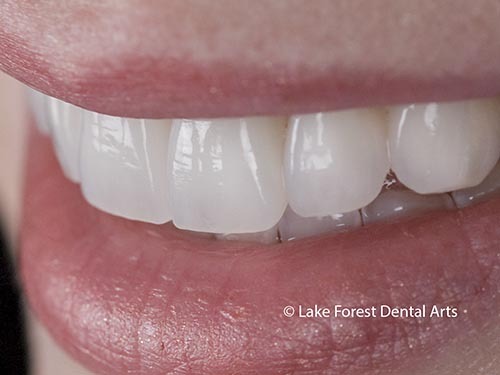
These feldspathic porcelain restorations on the front teeth will last at least 25 years.
Creating feldspathic porcelain veneers is a master craft method that few dentist/technician teams use. This method employs a laborious hand stacking technique. The ceramist applies small amounts of different porcelains mixing into a single monolithic layer. These porcelains vary in levels of opacity, brightness, and color, and are artfully laid down as the tooth form is built up. These veneers have artfully mixed porcelains that can match the existing tooth shades better than pressed coping veneers.
Cad cam and pressed glass ceramic alternatives require more thickness to mask unwanted colors. Feldspathic porcelain veneers require less drilling on the teeth because it matches better. The custom craftsmanship process of building feldspathic restorations yields a vibrant appearance that creates the most natural and life-like result for patients.
This type of veneer is desired due to unmatched blending capabilities as well as aesthetics. This ceramic choice is the least likely to ever have a black line at the gumline.
When is Feldspathic Porcelain Recommended?
Feldspathic porcelain is considered one of the most appealing cosmetic solutions. This veneering fabrication style may be recommended for patients when:
- The drilled tooth still has most of its enamel
- The patient does not grind their teeth
- When shade matching is difficult
- With extremely demanding patients
Feldspathic porcelain restorations have been losing market share in the United States. It is not because this hand crafted type of veneer is of less quality. When done well, they last just as long. In the rapidly evolving world of cosmetic dentistry, the market for feldspathic porcelain veneers would disappear instantly if that were true.
This type of porcelain system takes longer to make than pressed ceramic versions and requires more training for both the lab and dentist. They are usually more costly to produce and are more difficult for the dentist to deliver. Creating and providing feldspathic ceramic versions is an art that is mainly left for the high end market.
Are feldspathic porcelain veneers strong?
It depends on your dentist and how much tooth is left when the drilling stops. They are very strong when your dentist is conservative with the drill and leaves the majority of enamel in place. Feldspathic porcelain bonds extremely well to enamel. The tooth is actually strengthened by the presence of the new veneer.
The feldspathic restoration is considered monolithic with one type of porcelain. It does not have a strong coping substructure to support it. The tensile strength of 85 MPa is low on its own and needs to be treated like fine china until bonded onto the tooth. This type of restoration gains its strength from the bond to enamel. If supported and bonded to enamel, it is incredibly strong.
Most dentists drill too much tooth structure away for this type of veneer. Often less than 50% of the remaining exposed clinical crown has enamel to bond to. If this is the case, then the feldspathic porcelain restoration will be one of the weakest options. It would be contraindicated for patients who are tough on their natural teeth. Understandably, the choice of restorative material is often made intra-operatively. When more than 50% of the enamel has been removed during the drilling process, a crown might be a better option. Crowns don’t require as much enamel for bonding.
Dento-facial Analysis
If any type of cosmetic dentistry is requested, the more qualified cosmetic dentist or prosthodontist will do a dento-facial analysis. This analysis is an assessment of how the face and lip symmetry affect how the teeth display in a smile. The lips are said to be the picture frame for the teeth. It is customary for the dentist to take a series of photographs documenting the smile at many angles as well as how the gum tissue is shaped. Measurements are then taken on major landmarks on these images and compared with prevailing norms. If any ratios vary “significantly” from the norm, then the patient is offered the customary and usual treatment options to fix the problem. It is the patient’s right, privilege, and responsibility to make the final decisions on what treatment offerings are done based on the individual’s vision of importance.
Learn more about Master Craft Dentistry
The custom craftsmanship process of building feldspathic ceramic yields a vibrant and vital appearance to the dental restorations. This helps to create the most natural and life like smile makeovers that can be achieved. If you would like to learn more about feldspathic porcelain veneers, schedule a consultation with Dr. Fondriest by calling 847-234-0517.
Dr. Fondriest is a Nationally recognized and highly sought after cosmetic dentist. He serves clients from throughout the United States