
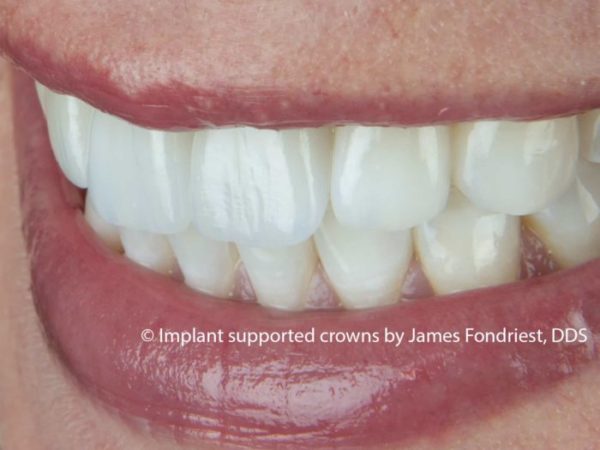
So many patients worry that their dental implant crowns won’t be as pretty as their natural teeth. If they find a good implant surgeon dentist team, then ideal results can be achieved. In this picture, the front two teeth are implant crowns but you would never know it. This Hinsdale patient was thrilled when she first looked in the mirror. Do you want a new tooth?
Replacing missing or extracted teeth with Dental Implants
Dental implants have become our favored way to replace missing teeth. Teeth can be lost due to periodontal disease, advanced decay, or by an accident or injury. Dental implants act as safe substitutes for the roots of your missing teeth. Similar to artificial joints, dental implants are made of specially treated titanium that is totally bio-compatable. Human bone is actually attracted to the titanium implants and will grow towards and attach to the surface. These fixtures can be placed into the jawbone in the location of a missing tooth and will serve as a foundation or support for a replacement tooth crown. They will look, feel and function just like your natural teeth. Implants can also be used to hold or support dentures and bridges.
Advantages of titanium implants
There are numerous advantages of dental implant treatment over other traditional treatment options. For instance, it is not necessary to drill on the bordering or adjacent teeth. If you do a dental bridge, drilling would be required. Implants can hold dentures so the ugly metal clasps (the anchoring mechanism for a partial denture) aren’t needed. Titanium fixtures spare the many problems associated with traditional false teeth. Just by placing an implant, the teeth around it will be made stronger.
Bone preservation | Implants will preserve the bone
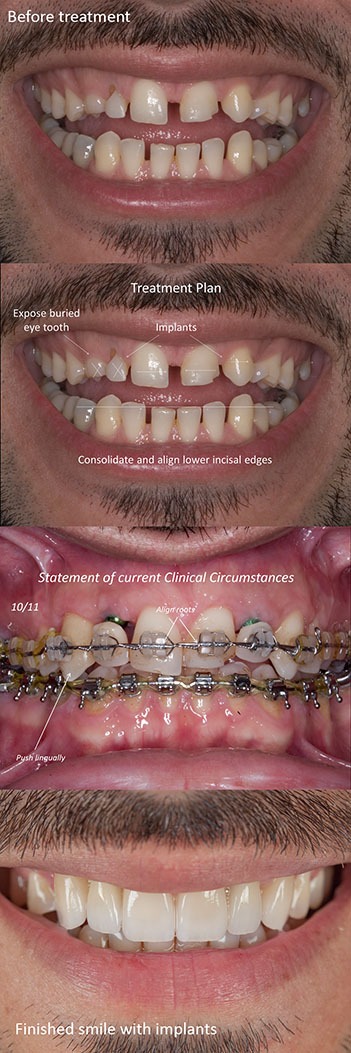
Start to finish smile makeover treatment that used braces and dental implants to transform his smile.
When a tooth is lost, it is normal for the jaw ridge to shrink leaving a defect. Normal bone stays strong and dense if it is stimulated. The normal stimulation of chewing is provides all of the torque needed. A lost tooth causes a decline in your jawbone strength. Implanted fixtures help to preserve the gum ridge and the jaw bone density. They provide the healthy bone stimulation that was previously provided by the natural tooth roots. This helps maintain the integrity of facial structures.
If you have missing teeth, dental implants are the best option to restore the look and functionality of your teeth. Chicago implant dentist, Dr. Fondriest will provide this option for patients who want to restore the beauty of their smile while replacing teeth that have been lost.
What planning does the Implant Dentist do?
The implant dentist and patient must first come to an agreement as to where and how many implants are to be used. Ideally, dental CT scans of the jawbone are taken. They evaluate for jawbone quality and quantity. Special stents are made to wear while the x ray is taken. These stents have markers that show in the x rays. These markers are placed in the preferred location of the planned implant. Your dentist will work closely with local specialists who surgically place the titanium fixture. Together, they will choose the exact location. They will also choose the size of the fixture together. High surgical skills are needed to place fixtures in the correct location within the jaw. Often a guide is made for the surgeon to ensure the proper placement of the fixture.
When a tooth is lost and not replaced in a timely way, it is possible that the proximal teeth will drift into the open space. Due to the realities of life, treatment delays happen. Commonly the space is found to be too small for a normal sized fixture. In this case, the patient has a choice of either reopening the space with braces or doing bridgework instead of the dental implant.
What if the x rays show there isn’t enough bone for the implant
Depending on the circumstances of prior treatment, there may not be a sufficient amount of jawbone volume at the desired location either. Gum and bone grafts are frequently done months prior to fixture placement to create the ideal bone shape and strength. When the graft heals and the size of the boney ridge has been deemed sufficient, the surgeon places the titanium implant into the jawbone.
Once the fixture has healed, a permanent restoration is made to attach to it. Your dentist decides how the final crown will be made. A cheaper way is to use “one size fits all” generic parts off the shelf. Alternatively, custom made parts can be used. Better parts improve the esthetics, length of service, and your ability to clean. It is easier to create a perfect bite with custom parts. Success rates are 96% for the upper jaw and 98% for the lower jaw. These rates are only for quality full protocol implant restoration.
Implants in a Day
Consumer Alert: Consumers must be cautious of heavily marketed “fast implant” treatment offerings.
Some prosthodontic surgical teams will compromise standard and accepted treatment rules to shorten treatment. Too good to be true treatment speeds often are too good to be true. In an effort to shorten treatment time, many stronger, more aesthetic, and higher quality treatment options may be ignored. Overall, quality of life may be lost and long term success rates ARE substantially lower.
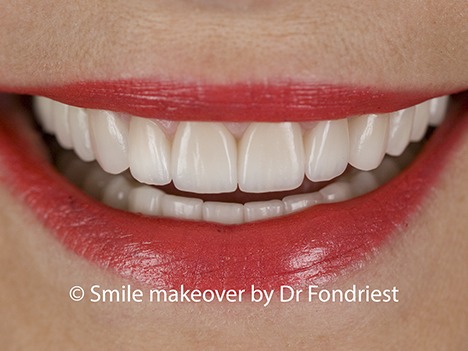
This Kenilworth patient wanted a remake of all of her recently done dentistry. Every tooth in the above smile is a crown on either implants or natural teeth. Can you tell which crowns are supported by implants? See her before and after images.
How do dental implants work?
Although placing the implant can often be difficult, it is rarely traumatic to the patient. The vast majority of placement surgeries are much easier than the original tooth extraction. The healing process after placement consists of the gum and bone growing around and attaching to the fixture. The gum heals in one to two weeks but bone healing or “osseointegration” takes much longer. Until it does, the implant should ideally should be left undisturbed and unloaded (not subjected to any torque or chewing forces) to get maximum bone in-growth. Improvements to the surface of the titanium is shortening the time it takes for full healing or osseointegration. Some fixtures placed into the lower jaw can be loaded after only 3 months of healing.
The UCLA Abutment
Once osseointegration has been achieved, a prosthodontist or specially trained restorative dentist will connect a crown to the implant with an intermediate connector. This intermediate connector, called an abutment, can be a generic mass produced “stock” item or a custom made “UCLA Abutment” that maximizes the esthetics, occlusal function, and hygienic changeability of the attached crown. Your dentist will choose the amount of customization that is put into the intermediate abutment as well as the implant crown placed on top of it. The cost of the lab bill and overall service generally matches the market and quality niche of the dentist. When looking for an accomplished doctor to do your implants, consider one who teaches on the subject and has written many articles on restorative dentistry.
With time, skill, and dedication to excellence, properly placed dental implants have a 98% success rate in the lower jaw and 96% in the upper jaw.
Dr. Fondriest is a Nationally recognized and highly sought after cosmetic dentist. He serves clients from throughout the United States